
We reviewed over 60 studies about what makes for a dream job. Here’s what we found.

An update to the most popular article I’ve ever written, and the first chapter of my new book.

We all want to find a dream job that’s enjoyable and meaningful, but what does that actually mean?
Some people imagine that the answer will come to them in a flash of insight, while others think what matters is that their dream job is easy and well paid.
At 80,000 Hours, we’ve reviewed three decades of research into what makes for a satisfying career, drawing on hundreds of studies, and didn’t find much evidence for either conclusion. Instead, we found five key ingredients of a dream job.
They don’t include income, nor are they as simple as “following your passion.” What’s crucial is to get good at something that helps other people.
Let’s start with where we go wrong.
Don’t follow your passion
For most of history, people tended to do the same things as their parents. Then the focus moved towards getting a stable job that would let you buy a house and a car. But my generation grew up with different advice: if you want a fulfilling career, follow your passion. From around 2005, this became a defining focus of career advice.
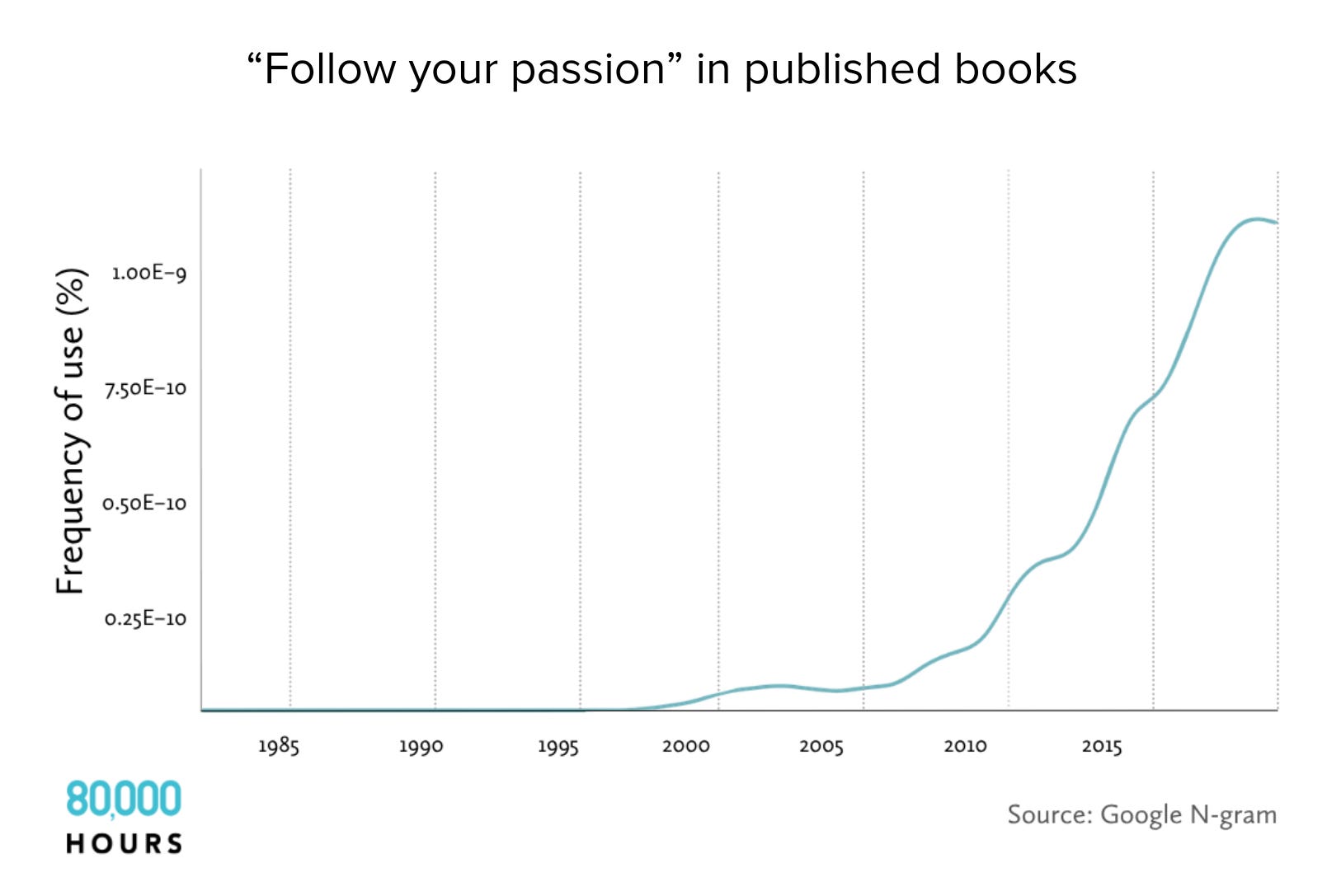
The subtext is that finding a great career depends on identifying your greatest interest — “your passion” — and pursuing it full time. It’s an attractive message: just commit to what you most enjoy and you’ll have a fulfilling career. And when we look at successful people, they are often passionate about what they do.
We’re also fans of being passionate about your work. As we’ll discuss shortly, intrinsically motivating work makes people a lot happier than a fat pay cheque. However, there are three main ways that “follow your passion” can be misleading advice.
The first is that many people don’t feel like they have a passion that could be relevant to their career. Telling them to “follow their passion” at best doesn’t get them anywhere, and at worst, makes them feel inadequate and demotivated.
Second, this advice suggests that passion is all you need. But if a basketball fan works with awful colleagues, receives unfair pay, or finds the work meaningless, they’re still going to dislike their job, even if they work for the NBA.
Likewise, someone who’s passionate about acting but ends up 40 and unemployed might have some regrets. In fact, “following your passion” can make it harder to secure the ingredients we’ll argue are most crucial for being satisfied with your job, because the areas you’re passionate about are likely to be the most competitive ones.

A survey of 500 Canadian students showed that their top passions were dance and ice hockey. Almost 90% said their greatest passion involved either music, art, or sport. But census data collected around the same time shows that under 3% of Canadian jobs were in sport or the arts. So, even if only one in 10 of those students followed their passion, the majority would fail.1
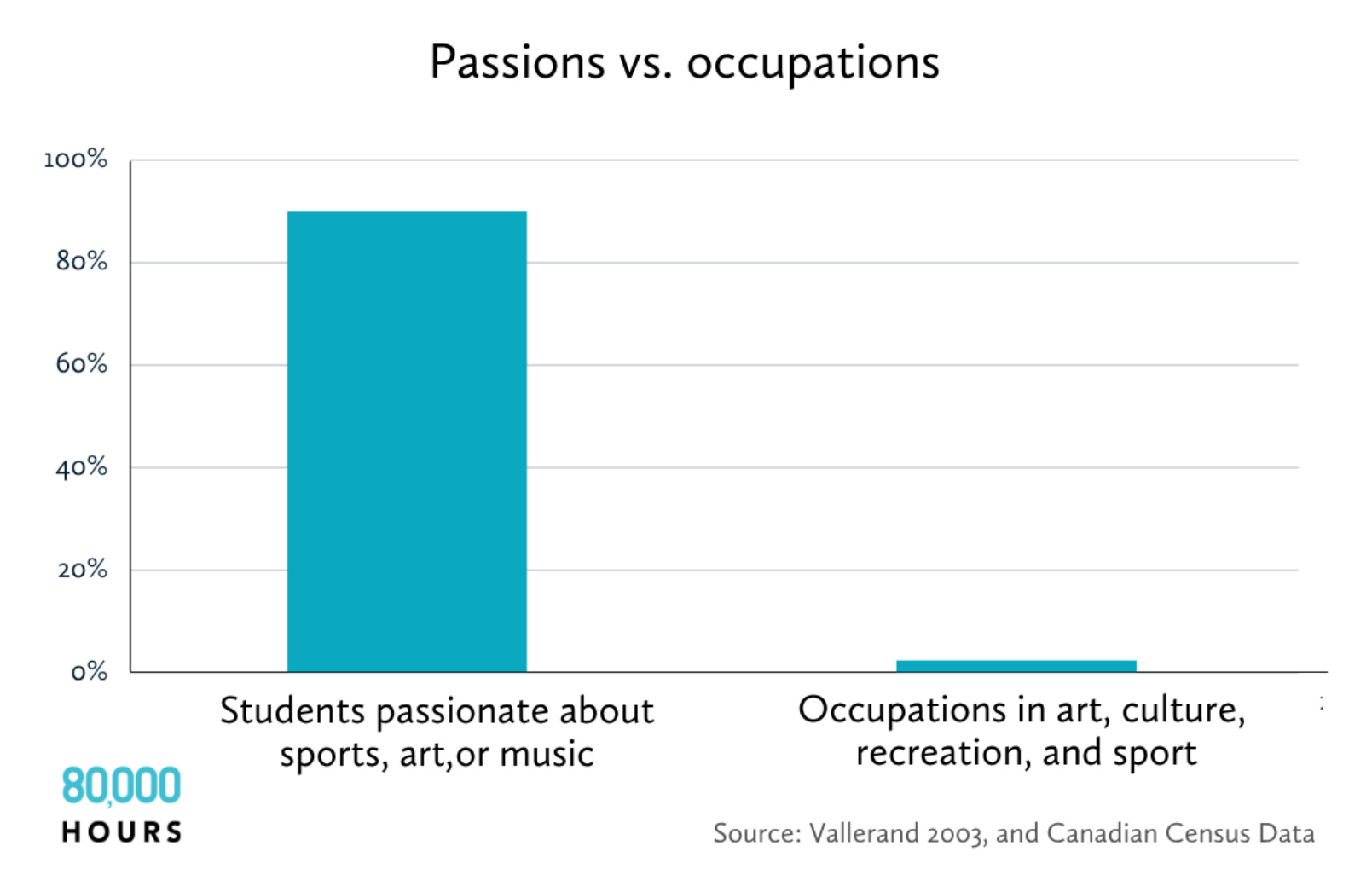
Moreover, even if you succeed in getting a job, researchers have found that the degree of match between your interests and your job correlates only weakly with job satisfaction.2
The third problem is that telling people to focus on what they’re already passionate about can make them needlessly limit their options. If you’re passionate about literature, it’s easy to think you must become a writer to have a satisfying career. But, in fact, there are probably many other jobs that could satisfy you, so long as they’re fulfilling in other ways.
Plus, our interests change over time, and more than we expect.3 Think back to what you were most interested in five years ago, and you’ll probably find it’s pretty different from what you’re interested in today. This means your interests are not an especially stable basis for career planning.
More perniciously, people often believe that their “one true passion” will be immediately obvious, leading them to eliminate options that don’t feel rewarding from the get-go. But most careers are a grind at the entry level, and you need to try things to learn what fits. That means it’s normal not to know what you’re passionate about right away. Instead, as we’re going to see, passion is something you develop over time — often in entirely unexpected directions.
We’ve worked with hundreds of people who developed passions for new career paths. Jess Whittlestone loved philosophy as an undergraduate, and was especially drawn to philosophy of mind. Naturally, she considered continuing to graduate school. But something held her back. Even if it would be intellectually interesting, if she didn’t make a difference, would it really be fulfilling?
After trying several paths, she settled on psychology and public policy. Over time, she found roles and topics that were meaningful, and became passionate about them. Eventually, she became the director of AI policy at a leading think tank, and in 2023, TIME named her one of the 100 most influential people in AI. We’ll explain how she got there in Chapter 11.
Why you shouldn’t follow your intuition either
Even if there was such a thing as your “one true passion,” how would you actually find it? The usual way is to try to imagine different jobs and think about how fulfilling they seem. If this were a normal career guide, we’d start by getting you to write out a list of what you most want from a job, like ‘working outdoors’ or ‘working with ambitious people,’ and trying to find jobs that match. The best-selling careers book of all time, What Color Is Your Parachute, recommends exactly that. The hope is that, deep down, people know what they really want.
But they don’t. Or at least, not particularly well. You can probably think of times in your own life when you were excited about a holiday or a party — only to find that when it actually happened, it was just OK. In recent decades, research has shown how common this is. We’re not always great at predicting what will make us happiest, and we often don’t realise quite how bad we are at it.4
It turns out we’re even bad at remembering how enjoyable different experiences were, let alone predicting them. A meta-analysis of over 50 studies found we remember experiences by how enjoyable they were at their peak, or at their ending, rather than how enjoyable we’d say they were at the time.5
In a classic study, people rated a colonoscopy as less painful if it ended less painfully, even if the pain lasted longer.6 As Dan Gilbert, one of the world’s leading experts on happiness, puts it:
The fact that we often judge the pleasure of an experience by its ending can cause us to make some curious choices.
This means we can’t simply trust our intuitions when trying to figure out what will satisfy us most. We need a more systematic way of working out which job is best.
What might a more systematic approach look like? It’s tempting to assume that your dream job will meet two supposedly appealing criteria: that it’ll be easy and well paid.
This is implicit in a lot of mainstream career advice. CareerCast provides one of the leading career rankings in the US. The first four criteria they use to rank careers are:
Is it unstressful?
Is there good work-life balance?
Is there high job security?
Is it highly paid?
Essentially, less-demanding, secure, high-pay jobs are rated more highly. Based on these criteria, the number one job turned out to be: actuary. That is, someone who uses statistics to measure and manage risks in the insurance industry. This is the same answer they gave back in 2015 when I first wrote about their list, and it’s been close to the top ever since.7
Would we all be happier if we retrained as actuaries? It’s true that actuaries are more satisfied with their job than average, but they’re not among the most satisfied. And only 36% say their work is meaningful.8 This shows that the factors used by CareerCast don’t capture everything. In fact, plenty of evidence suggests that money and avoiding stress may even be counterproductive to focus on. Let’s start with money.
Don’t chase the money
It’s a cliché to say that “money can’t buy happiness,” but better pay is often people’s top priority when looking for a new job.9 When people are asked what would most improve the quality of their lives, the most common answer is “more money.”10 Which side is right?
As is often the case, the truth is somewhere in the middle. After reviewing the best studies we could find on this question, we found that money does make you happy, but only a little.
For instance, here are the findings from a huge survey in the US:
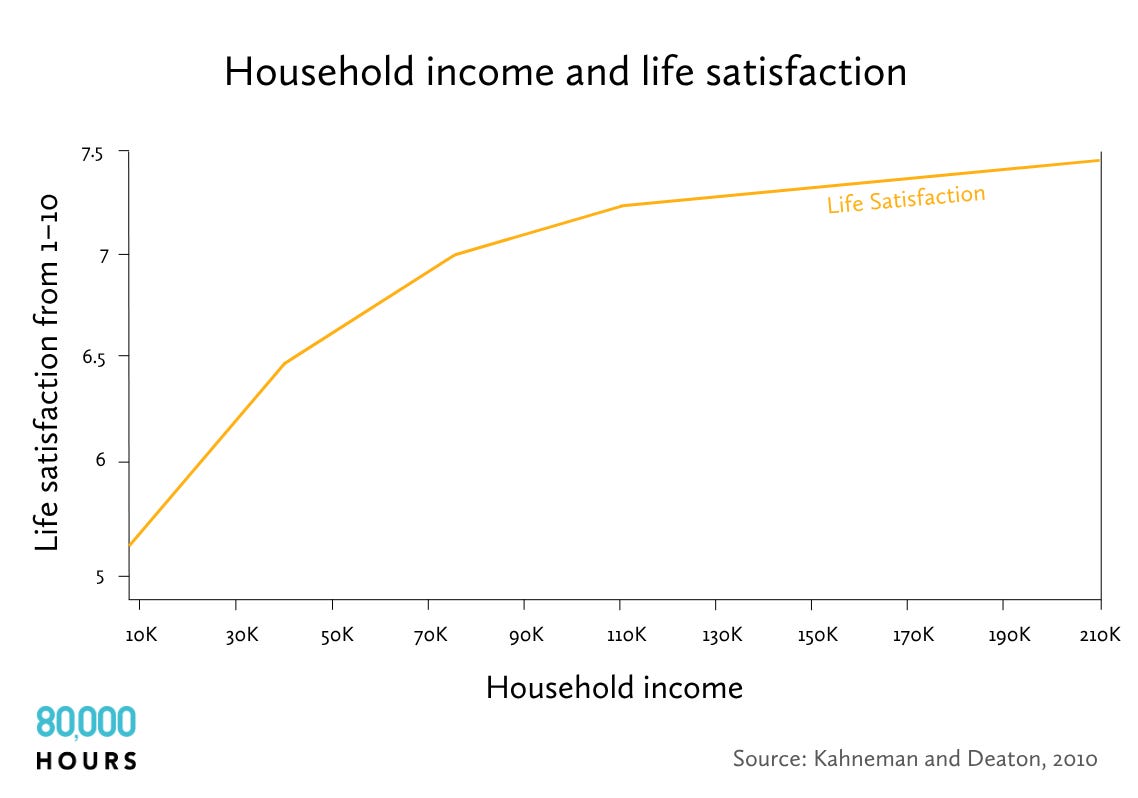
Respondents were asked to rate how satisfied they were with their lives on a scale from 1 to 10. The result is shown on the y-axis, while the x-axis shows their household income. The chart shows that an increase in pre-tax income from $40,000 to $80,000 was only associated with an increase in life satisfaction from about 6.5 to 7 out of 10. Gaining another half point requires another doubling to $160,000. That’s a lot of extra income for a small improvement.
This is hardly surprising. We all know people who’ve gone into high-earning jobs and ended up miserable. Your expenses creep up, and you soon come to take your salary for granted. At the same time, you’re working longer hours, eating into time with friends and family.
But even this might be overstating the importance of money. If we look at day-to-day mood, income appears to be even less important. The same study asked people at different salary levels whether they reported feeling happy yesterday, which the researchers called “positive affect.” The left-hand y-axis shows the fraction of people who reported “yes.” This line goes basically flat around $75,000.
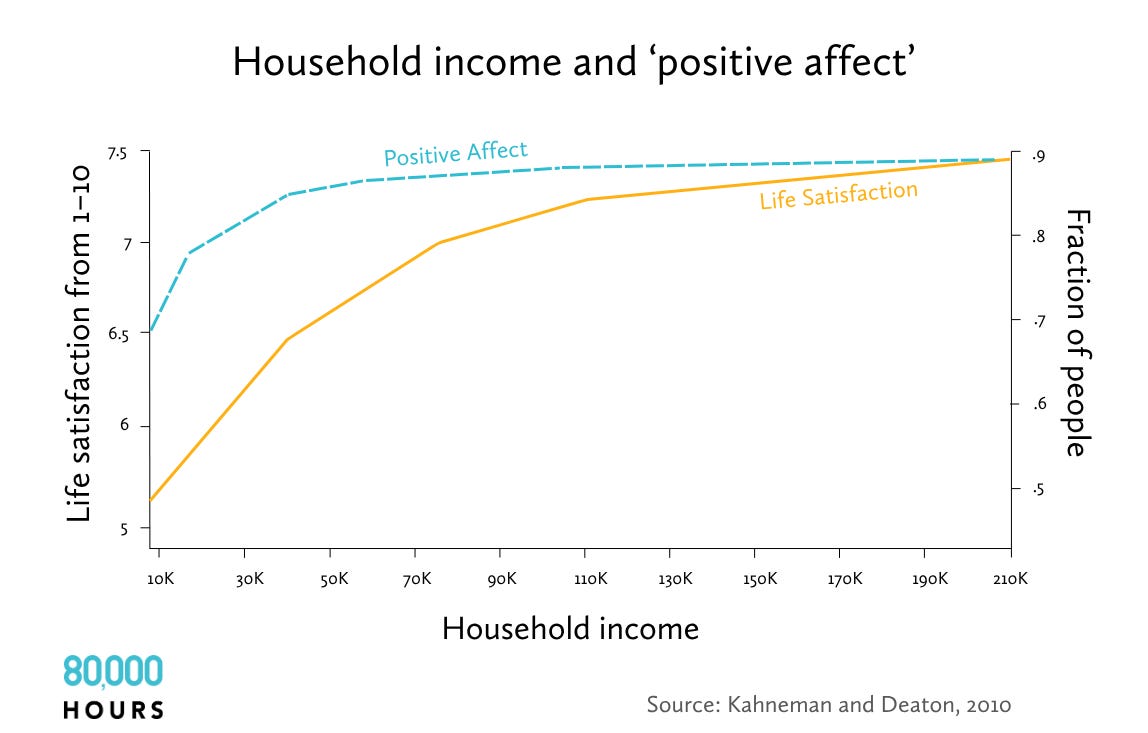
The picture is similar if we look at the fraction who reported being “not blue” or “stress-free” yesterday. (In fact, people got more stressed as incomes increased.)
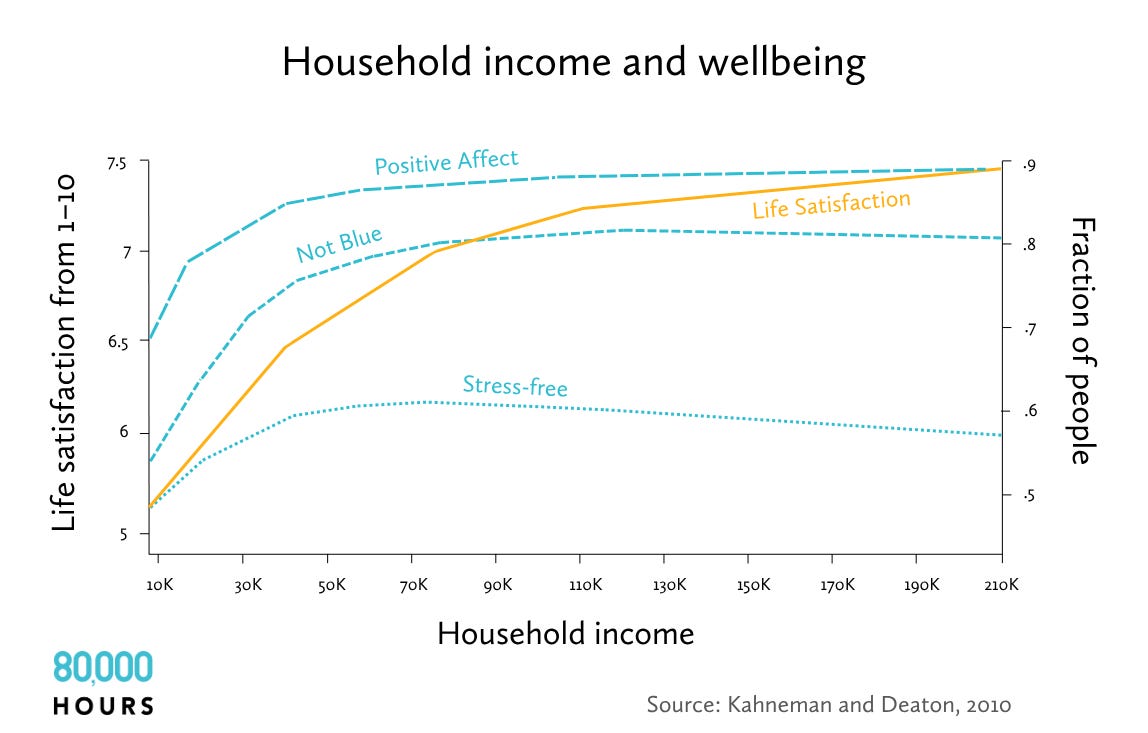
Admittedly, this debate is far from over. While this data shows that positive affect goes completely flat around $75,000, a more recent study from 2021 found that it actually continues to rise. It’s just that it rises very slowly, and more slowly than life satisfaction. This could be because high income makes people feel successful, even if it doesn’t make them happier.11
From a practical point of view, this doesn’t make much difference. Once you’re above around $100,000, money seems to make only a small difference to happiness.
Moreover, this data could still be overstating money’s importance. These studies are correlational, which means the relationship between money and happiness could be caused by a hidden third factor. For example, being healthy could make you both happier and allow you to earn more. Taking account of all the possible additional factors could reduce the impact of money even further.
How much income should you aim for, given your individual situation? The graphs in this chapter are for household income in 2009, but the average household in the US has 2.5 people. If you’re single, your costs will be a bit higher, so economists would typically say $100,000 of household income is equivalent to income of about $50,000 living alone.12 Adjusting for inflation gets you to about $75,000 in 2025.13 Each dependent you have living with you will add another half to that.
These are also averages for the US as a whole. If you live in an expensive city like New York, you’d need to add about 50% to account for the higher cost of living,14 and because our satisfaction is highly driven by how our income compares to others around us. Compared to New York, incomes and cost of living are another 10–20% higher again in Zurich, but 20–25% lower in London, Paris, and Sydney, and 60–80% lower in Shanghai.15 Compared to the US as a whole, incomes in the UK are about 40% lower16 and cost of living is about 10% lower. This suggests that $75,000 in the US is equivalent to about £42,000 in the UK,17 or $115,000 in New York.
As of 2023, the average university graduate in the US can expect to make about $77,000 per year over their working life, while the average Ivy League graduate earns over $120,000.18 In the UK, university graduates earn about £52,500, and amounts are similar in Western Europe and Australia.19 The upshot is that if you’re a university graduate in a high-income country, then there’s a good chance you end up in the range where more income has little effect on your happiness.

Don’t aim for an easy life
Many people tell us they want to find a job that isn’t stressful. And, in the past, doctors and psychologists believed that stress generally was bad for us. However, more recent evidence on stress suggests the picture is a bit more complicated.
One puzzle is that studies of high-ranking government and military leaders found they had lower levels of stress hormones and anxiety than other workers, despite sleeping fewer hours, managing more people, and having more responsibilities.20
One widely supported explanation is that having a greater sense of agency shields them from the demands of the position. In other words, if you’re facing a stressful project, but you get to decide how to go about tackling it, it’s likely you’ll feel much better than if you’re being micromanaged.
Likewise, a stressful project that’ll only last one week might not be a problem, while one that lasts for two years certainly could be. People are also much better able to tolerate stress if it’s in pursuit of a goal they consider meaningful.

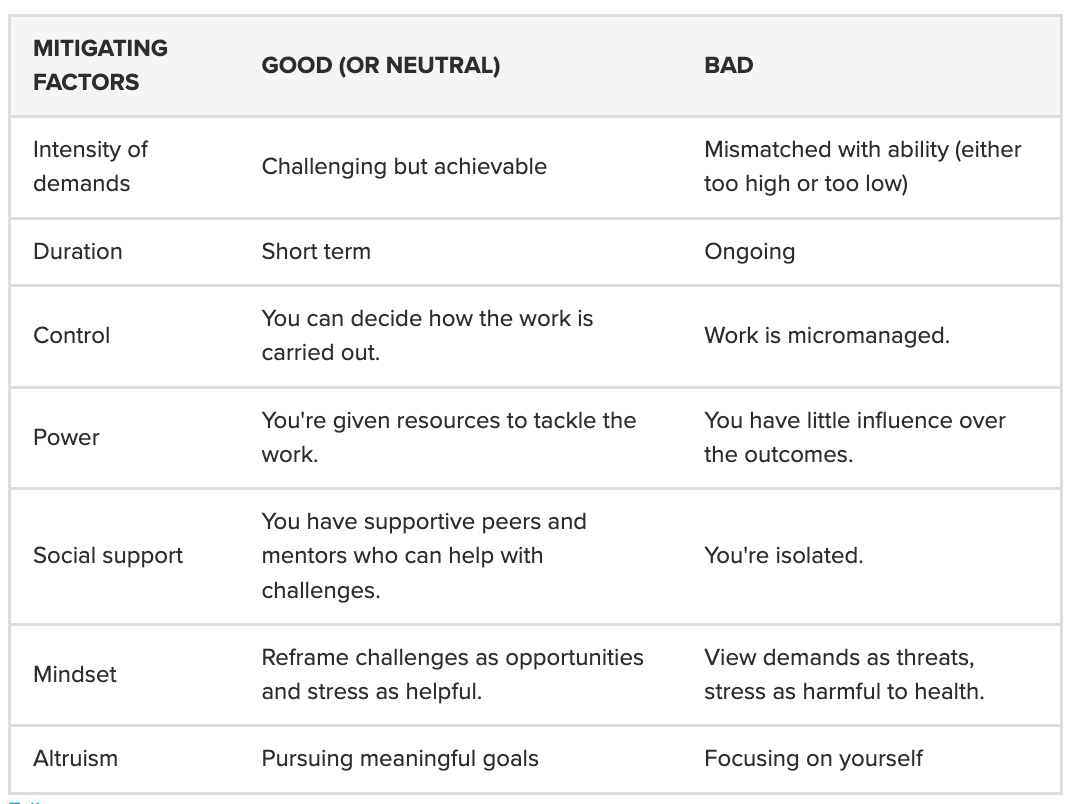
In total, researchers have found that the following seven factors are important moderators of stress, and can even turn a situation that’s draining into one that’s engaging and meaningful:
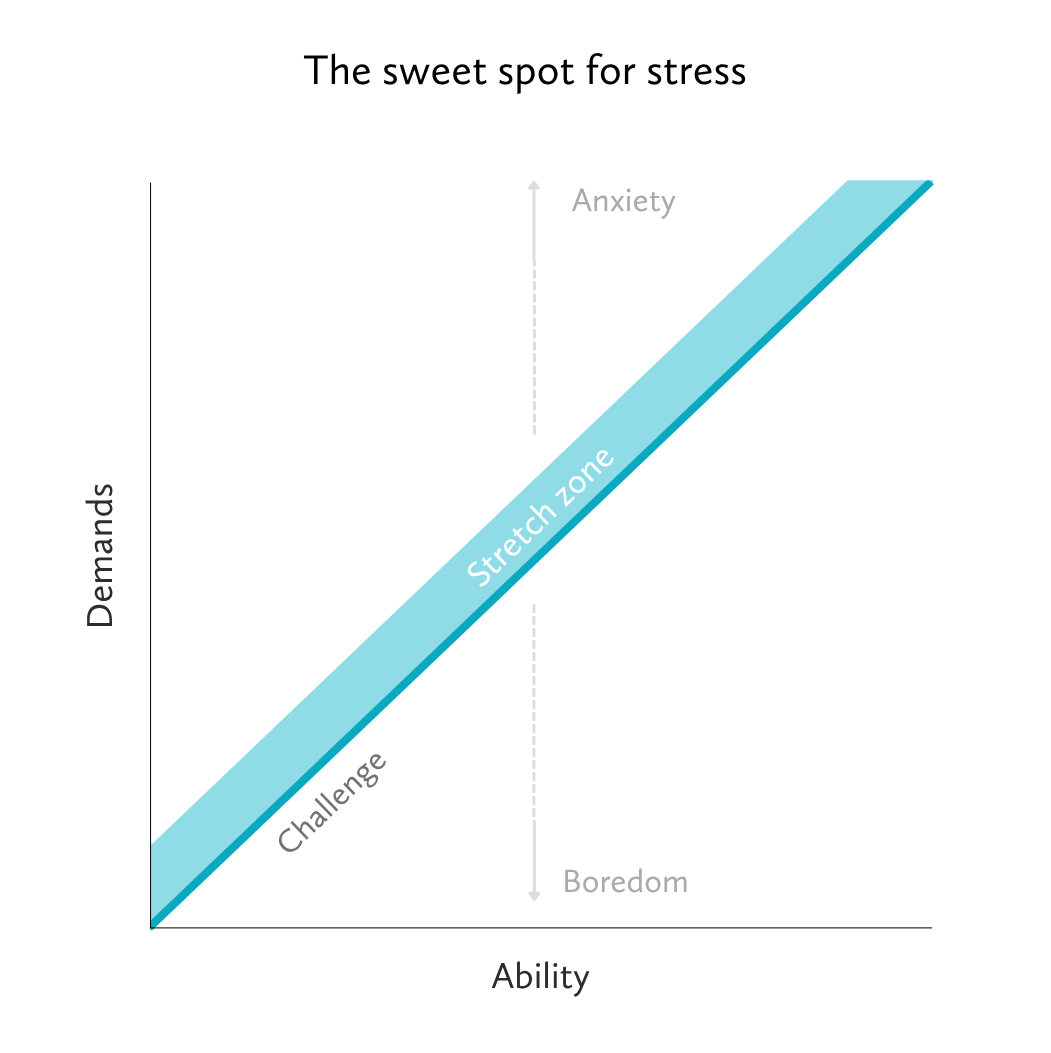
This research points to a very different conclusion about how to approach stress. Having a very undemanding job is actually bad — it’s boring. But, at the same time, facing demands that exceed your abilities is also bad because that causes harmful stress. The sweet spot is where the demands placed on you slightly exceed your current abilities — that’s a fulfilling challenge.
All this hints at an alternative way of thinking about a “dream job.” Instead of seeking out low-stress jobs, seek a supportive context and meaningful work, and then embrace tasks that challenge you.
What you should really aim for in a dream job
Instead of following your passion, be systematic in working out what will or won’t bring satisfaction. There have now been three decades of research into positive psychology — the science of happiness — to guide us towards what that might be, as well as decades of surveys and research looking at job satisfaction and motivation in particular. We’ve applied all this to make the following five criteria for a dream job. (If you want to dig into the evidence in more depth, see our evidence review.)21
The first lesson is that what really matters is not your salary, status, or even your job title, but rather what you do day-by-day and hour-by-hour.
1. Work that’s engaging
Engaging work is work that draws you in, holds your attention, and enables you to enter a state of flow — the sense of immersion that emerges when absorbed in a task. It’s the reason rambling, incoherent meetings feel like pure drudgery, while an hour spent playing a video game can feel like no time at all: games are designed to be as engaging as possible.
Why are video games engaging while so many aspects of office life aren’t? In a major meta-analysis, researchers identified the following four factors, which have been called “the most empirically verified predictors of job satisfaction”:22
Freedom to decide how to perform your work
Clear tasks with a well-defined start and end
Variety in the nature of those tasks
Feedback, so you know how well you’re doing
These factors correlate about twice as much with job satisfaction as match between your interests and your job.23 And, while they are even more important for people who especially desire accomplishment and learning, they matter for everyone.
Interestingly, these four factors are about how your work is structured, not its content. Financial admin that’s been organised to feel like a game could create a sense of flow, while being made to sit through a health and safety presentation could bore you to tears, even if it’s in service to motocross racing, which happens to be your dream industry.
This said, while video games are intensely engaging, they’re not the key to a fulfilling life, and that’s because you also need the second critical ingredient.
2. Work that helps others
Here are three ostensibly desirable and engaging jobs. And yet, when questioned, under 30% of people doing them said they found them meaningful:24
Fashion designer
TV newscast director
Software engineer
The following three jobs, meanwhile, are seen as meaningful by almost everyone who does them:
Fire service officer
Nurse or midwife
Neurosurgeon
What’s the difference? Well, the second set of jobs tangibly help other people. That’s what makes them meaningful.
The studies we just covered also found a fifth key factor: the significance of the tasks. Tasks are more significant the more they impact others.
On top of that is a growing body of evidence to suggest that helping others is a key ingredient of life satisfaction in general. To give just a few examples, a meta-analysis of 23 randomised studies showed that performing acts of kindness makes the giver happier. People who volunteer are less depressed and healthier. And a global survey found that people who donate to charity are as satisfied with their lives as those who earn twice as much.25
In an attempt to sum up what’s been learned by the field of positive psychology to date, its founder, Martin Seligman, listed the most important drivers of wellbeing. One of them is engagement, and another is a sense of meaning.26 While helping others isn’t the only route to a meaningful career, it’s one of the most powerful.
3. Work you’re good at
Another key ingredient of fulfilment in Seligman’s list is a feeling of competence.27 This is the feeling you get from stretching your skills, especially valuable ones. It’s intrinsically enjoyable, adds to your ability to enter a state of flow, and builds your self-confidence. For most people, it comes from getting good at their work — whatever that may be.
Competence at work is not only satisfying, it gives you the power to negotiate for the other components of a fulfilling job — like the chance to work on meaningful projects, undertake engaging tasks, and receive fair pay. If people value your contribution, it becomes easier to negotiate for what you want in return.
This is why skill ultimately trumps passion. If you pursue a career as an artist but aren’t good at it, you’ll end up doing derivative and uninspiring design for companies you don’t care about — however passionate you might be about art.
That’s not to say you should only do work you’re already good at, but you do want the potential to get good at it.
4. Work with supportive colleagues
It may sound obvious, but if you hate your colleagues and work for a boss from hell, you’re not going to be satisfied.
Good relationships are Seligman’s fourth key ingredient of wellbeing, and perhaps the most important.28 Given this, it’s great if you can become friends with at least a couple of people at work. However, you don’t need to become friends with everyone, and you certainly don’t need to like all of your colleagues. One large meta-analysis found that ‘social support’ was among the top predictors of job satisfaction.
It doesn’t mean you should feel compelled to spend evenings and weekends together — but rather refers to whether you’re able to get help when you’re struggling. Another meta-analysis found several types of ‘organisational sponsorship,’ such as easily accessible supervisor support and training opportunities, were among the best predictors of career satisfaction.
This is also not the same as saying that you should surround yourself with people just like you. People who are disagreeable and have a totally different outlook can often give you the most useful feedback, provided they care about your interests deep down. This is because they’re more likely to tell it like it is. Organisational psychology professor Adam Grant calls these people “disagreeable givers.”
When we think about dream jobs, we usually focus on the role. But who you work with is just as important. A bad boss can ruin a dream position, while even boring work can be fun if done with a friend. As we saw with engagement, this is another way in which context beats content.
5. Work that isn’t actively unpleasant
Landing your dream job isn’t only about securing these positive factors; you also need to try and avoid forces that make work actively unpleasant. In the research we surveyed, each of the following was linked to job dissatisfaction:
A long commute
Very long hours
Pay you feel is unfair
Job insecurity
For example, one survey of over 60,000 people found that long commutes were associated with lower life satisfaction. The worst effects were associated with journey times lasting between 61 and 90 minutes. (And the worst mode of transport was buses, which, as a Londoner, makes perfect sense to me.)
Long hours can be handled when they are part of a time-bounded, meaningful challenge, but excessive and persistently long hours crowd out other parts of your life. Likewise, even if pay is only weakly correlated with happiness, the sense that you are being compensated unfairly compared to your peers is another matter.29
If your job is in the wrong city, that’s going to hurt your relationships, and satisfaction with location is a significant driver of life satisfaction.30 Likewise, look out for other major conflicts between your job and what you value in the rest of your life.
Although these sound obvious, people often overlook them. The negative consequences of a terrible commute can be enough to outweigh many other positive factors.
You don’t have to get all the ingredients of a fulfilling life from your job. It’s possible to simply find a job that pays the bills, and find meaning and satisfaction elsewhere. Many people get a sense of competence from a side project, or help others through philanthropy or volunteering.
Do what matters
How can we sum this all up? Rather than “follow your passion,” our slogan for a fulfilling career is: get good at something that helps others. Or more simply: do what matters.
We open with “get good” because once you get good at something that others value, you’ll not only have a sense of competence, you’ll also have more career opportunities in general, giving you a better chance of securing engaging work, supportive colleagues, and your other basic conditions.
You can have everything else in place, however, and still find your work meaningless. This is why you need to find a way to help others too.
Helping others is not only fulfilling; it can also make you more successful. Make it your mission to help others, and people will want to help you succeed. This sounds like it could be wishful thinking, but there’s some empirical evidence to back it up.
In his book Give and Take, Adam Grant argues that people with a ‘giving mindset’ are more likely to end up among the most successful, both because they’re more motivated by their desire to give, but also because they get more help.31
And, just in case you prefer appeals to authority over scientific studies, the idea that helping others is the key to a fulfilling life is a theme that recurs throughout many moral and spiritual traditions:
Set your heart on doing good. Do it over and over again and you will be filled with joy.
Buddha
A man’s true wealth is the good he does in this world.
Muhammad
Every man must decide whether he will walk in the light of creative altruism or in the darkness of destructive selfishness.
Martin Luther King, Jr
But even more so than in the age of these spiritual leaders, we’re going to see that each of us has an enormous opportunity to help others. Ultimately, this is the real reason to do it.
We can now see that “follow your passion” gets it backwards. Rather than start with our preexisting passions, hoping that success and fulfilment will follow, we should start by “doing what matters.” By building valuable skills and devoting them to meaningful challenges, passion and a truly fulfilling life will emerge over time.
Hopefully this is a relief — you don’t need to figure out your one true passion right away. In fact, you have more options for a fulfilling career than you think. Twenty years ago, I would never have imagined being passionate about careers advising — that would have sounded totally dull — but here I am, writing this guide.
This is the reason we founded 80,000 Hours — our mission is to help you find a career that contributes. It’s best for you, and it’s best for the world. The rest of the book will unpack how, starting with a simple question: which jobs actually help people?
Anyone who preorders a physical copy of the book will be able to access a live Q&A marathon where I’ll answer any questions about your career. Buy 5 copies to giveaway and we’ll thank you by name in the next edition. And for orders over 25+ we can get discounts up to 40%. This really helps us rank in the bestseller lists. Ask here.
Thanks for this. I remember when I started doing public speaking I didn’t have a passion for it because I didn’t really know what it was. I used it as a tool to develop myself and I developed the passion after practicing. So I relate with “follow your passion” being the wrong advice.